
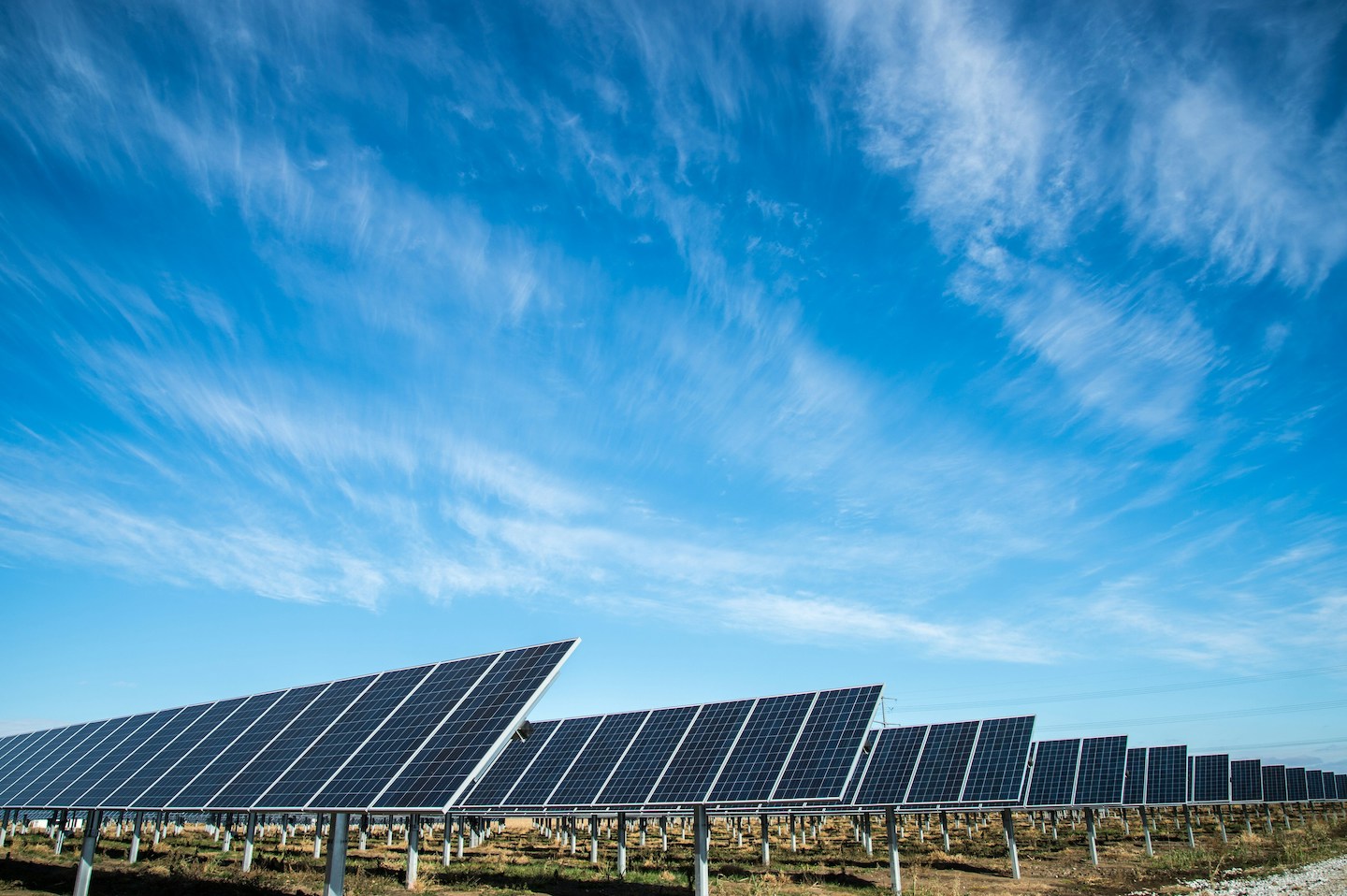
So far, the Land Development in Greece column series has focused on land development for private residences, tourist developments, eco-neighborhoods and conscious construction projects. October’s article takes a different approach and looks at a popular trend currently taking place in Greece: Land Development for Renewable Energy. In other words the use of a large land mass to create energy which comes from natural resources, be it sunlight, wind, geothermal heat, biofuel, biomass, hydroelectricity, rain, tides and waves. In this article we’ll focus on solar energy because it’s currently most popular in Greece among investors.
Invest in Greece describes The Renewable Energy Sector as “a strong market with potential for growth.” The country apparently offers the right landscape and an abundance of it, the right weather and more importantly the right incentives for keen investors looking for opportunities in sustainable sources of energy. Skeptics however say that the industry is just another bubble waiting to burst and when the government subsidies run dry so will the industry. Tekmon Geomatics is on a quest to find out the facts.
STEP 1:
ONCE A SOLAR PARK IS LICENSED AND ESTABLISHED IT IS READY TO PRODUCE ENERGY. THE SUN HITS ITS SOLAR PANELS.
STEP 2:
THE SOLAR PANELS COLLECT ENERGY FROM THE SUN AND CONVERT IT INTO AN ELECTRIC CURRENT.
STEP 3:
ELECTRICITY IS PRODUCED. THE KILOWATT (KW) IS THE UNIT THAT EXPRESSES THE POWER PRODUCED.
STEP 4:
THE ELECTRICITY MARKET OPERATOR (ΛΑΓΗΕ IN GREEK) PAYS ITS RENEWABLE ENERGY PRODUCERS (I.E. THE SOLAR PARK INVESTOR) A FEED- IN-TARIFF FOR THE AMOUNT OF KWs THEIR SOLAR PARK PRODUCES PER HOUR.
STEP 5:
THE ELECTRICITY IS SENT TO THE NEAREST CENTRAL ELECTRICITY GRID – OWNED BY THE PUBLIC POWER CORPORATION AND MANAGED BY THE HELLENIC ELECTRICITY DISTRIBUTION NETWORK OPERATOR.
STEP 6:
HERE, THE ELECTRICITY IS STORED AND DISTRIBUTED TO CONSUMERS.
For privately owned land plots, investors can make enquiries directly with the owner (if known) or can visit an estate agent. The land owner will then either sell or lease the land. Land prices will vary according to location but are usually negotiable.
For publicly owned land plots, investors can make enquiries to the local municipality of the area that interest them. Greece has set a target for 20% of its total energy to come from renewable sources by 2020. Hence procedures are in place to avoid unnecessary delays and the process is usually straightforward. Once communication is established (preferably with the Mayor), then the Municipality could either sell or lease the public land to the interested investor. In some cases, municipalities will even hold public tenders for potential investors to bid on leasing a favourable land plot made specific for renewable energy installations.
Investors wishing to develop a solar park need to make sure that the land plot is non arable, exists outside the boundaries of a settlement or national park and is exempt from being an archeological or pre-historic site. Depending on the solar park’s installed KW capacity, the investor must possess a number of relevant documents prior to commercial operation. As a general rule, less KWs produced equals to less legislation required. This table provides a brief overview of the documents required depending on a solar park’s installed capacity.
It clearly depends on capacity. The land plot’s size will vary according to how much energy an investor can afford to produce. Also, the photovoltaic make, quality and its potential for energy production also play a role. On average, one can make the assumption that 40 square meters are required for a capacity of 1 KW worth of solar energy.
Presently, there are many companies that specialize in solar park installations and therefore the industry is competitive – an advantage for investors. Nevertheless, it’s best to shop around. Construction companies are able to breakdown and explain all related costs. A common size for a solar park in Greece has a capacity of 100 KW installed over a 4000 square meter land plot. Excluding land related costs, licensing and connection costs, construction costs are on average 3.000 euros per KW of installed capacity. For a solar park with the potential to produce 100 KW worth of solar energy the total cost is on average 300.000 euros.
Feed-in-tariffs (€/KilowattPerHour) trends in Greece
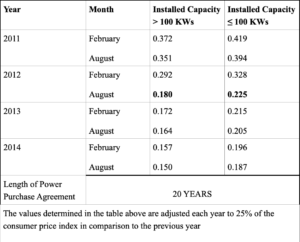
The feed-in-tariffs for renewable energy sources are determined by the Ministry of Environment, Energy and Climate Change usually following a proposal from the Regulatory Authority for Energy. On the current feed-in tariff (see table) the return on investment will vary between 5 to10 years depending on the project’s financing scheme. After all costs are recovered the investor begins to generate profit.
In order for Greece to become competitive with its European counterparts and be able to sell to them in the future, The Ministry of Environment, Energy and Climate Change has recently reduced the feed-in-tariffs paid to its Energy Producers. This essentially means that investors in renewable energy production will take longer to recoup their costs.
Nevertheless, Greece is and will remain a buyer’s market for the foreseeable future. As Greece’s recession continues, the renewable energy industry will also continue to be competitive. Land, licensing and construction costs will decrease in parallel to the tariffs therefore still making an investment in renewable energy worthwhile. In addition, it seems that renewable energy is here to stay. Fossil fuels are expensive and damaging to the environment so governments are looking at alternative sources of energy as the way forward. With new measures and reforms being implemented as part of the memorandum, an investment in renewable energy is Greece is presently considered one of the safest. Finally, Greece encourages the production of energy from many sources. While this article only focuses on solar energy, investors are strongly encouraged to equally look into other sources of energy production as a financially and environmentally sustainable investment route.