
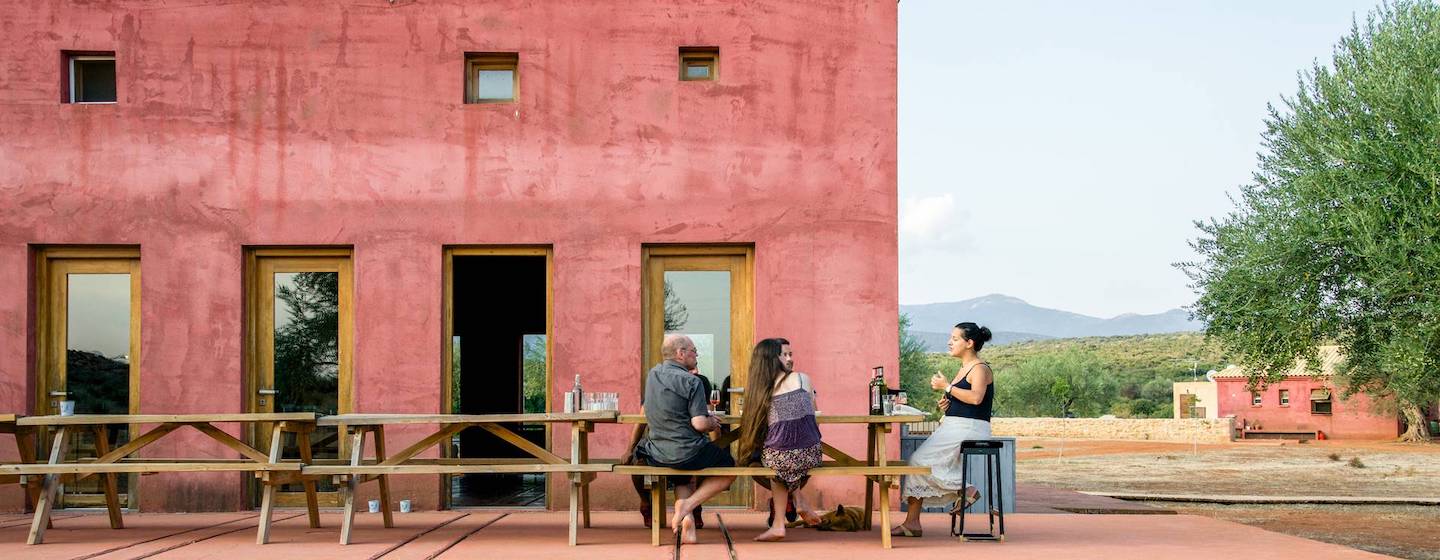
Spring is here (goodbye winter), flowers are blooming and summertime’s looming especially in the southern Peloponnese region where the year round warm climate allows for almost anything to come to life.
This month Tekmon Geomatics talks to Frangiskos Karelas who in 2003 established his organic farm and called it Euμέλια (it means melody in Ancient Greek) and has since seen it grow into an Organic Agrotourism and Guest House Company.
Frangiskos studied Political Science and International Relations at Syracuse University in New York, completed his Masters at Johns Hopkins University in conflict resolution, worked for the European Parliament and the United Nations but it was his concern for the environment and interest in Human Rights that gave him the motivation to establish euμέλια on a 20 hectare land plot (200,000 m2) inherited by his great grandfather and located 45 minutes south east of Sparta.
“I was always travelling, I lived in 6 different countries, I was a citizen of the world but there wasn’t a place on earth that I could call home and I felt a need to do something with this land.” explains Frangiskos.
While Euμέλια’s humble start was an organic farm the long term idea was to work with the land, expand it non-intrusively and with a minimal impact on nature. “The approach was no bulldozers” says Frangiskos.
Thereafter, grape vines, olive groves and additional plantations were cultivated. The farm began to offer field trips and environmental education to schools. Wine making and tasting seminars in addition to olive picking were introduced. Yoga and Tai chi classes as well as meditation retreats followed. Finally, the hotel facilities were built on a separate patch with eco-friendly materials to accommodate travelers. It’s interesting to note that while Frangiskos’ land plot allows for up to 6,000 square meters worth of building capacity only a fraction of that (600 square meters) has been utilized for building purposes. The remainder of the land is dedicated to farming and related activities.
It hasn’t been all easy sailing though especially from a bureaucratic perspective. Prior to any parcel of land being utilized in any way, a certificate from the Local Forestry Department is required that defines any prohibitions to build. An analogous certificate is required by the Local Archeology Authority that defines any further prohibitions to build. Finally the local urban planning office assesses if the plot is within a protected area and provides the building permit. For all tourist accommodations an operational license from the Greek National Tourism Organisation is also required.
Frangiskos tells me that the concept of a multifunctional farm is new in Greece and a new framework tailored for such cases is being implemented in order to allow for a quicker process. “It’s easy to say I want to create a multifunctional farm and I want to be able to offer cooking facilities, and receive guests and take them for hikes and have animals on the premises and so on, and only need one sort of approval” asserts Frangiskos. Though, the reality is that Euμέλια had to first be certified as an organic farm and get separately assessed and certified by the forestry and archeology departments as built-able. Its natural water recycling technology needed special approval from the Ministry of Health and took about 1.5 years to obtain.
The company is a Société Anonyme as this title best suits the company’s needs and all the various activities that it offers, from renewable energy installations to offering Greek cooking workshops to hosting art exhibits. There is even an e-shop that sells products straight from the land with the US being the main export destination.
“Who visits Euμέλια and how do people find out about the farm?” I ask. “We have very good communication with the US, Canada and England. I know these markets very well and they’re progressive on sustainability issues so there is a lot of interest coming from these parts of the world” Frangiskos tells me.
According to Frangiskos what makes Euμέλια really unique is that it unites individual sustainability projects all in one space. “We’re not saying that we’re great at everything but we’re unifying all aspects of sustainable living and creating a new model for discussion.”
Ten years after Euμέλια’s birth Frangiskos tells me “it hasn’t been easy because when you’re one of the first to try out something, costs are higher, you’re creating a new market, bringing in new technologies, there is a higher risk of implementation all on a small scale and agro tourism is still in its infant stages in Greece.”
But for the truly committed traveler, Euμέλια is worth exploring. It’s off the beaten track which makes it all the more attractive. Advertising is kept at a low cost and most marketing happens through word of mouth in addition to social media and a newsletter.
“What does the future hold for Euμέλια?” Ι ask. “We need people to help out and we’ve got a natural lake project underway so we’re crowdfunding to make it a reality because at the moment this is really what’s missing” says Frangiskos enthusiastically.
We’re always keen to listen and share people’s stories and the ways in which they’ve utilized Greek land. We wish Frangiskos and Euμέλια all the best in their future endeavors. If you’ve got a story to share or would like to contribute an article to the Land Development in Greece column series please email me at irene@tekmon.gr
Frangiskos Karelas, MA in International Relations & Crisis Management (SAIS) Johns Hopkins University, Head of Office of MEP and Chairman of the Transportation & Regional Policy Committee of the European Parliament. Project Manager for Development Projects in NGO’s in Council of Europe & UNHCR. Founder & President of Homeodynamic Development S.A. the parent company of Eumelia Organic Agrotourism Farm & Guesthouse.