
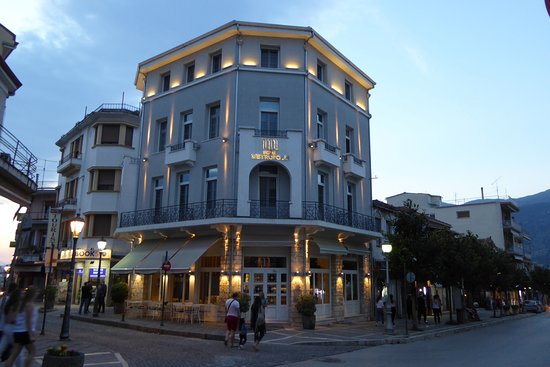
Do you renovate a historic landmark? This is an issue that has traditionalists and modernists debating endlessly. But what if you could preserve the old by adding a modern spin? This is precisely what Eythimios Lytsikas did with the Metropolis Hotel, a landmark establishment located in the very heart of Ioannina City – a town of 100 000 inhabitants with a strong historical influence in Northwestern Greece. The Metropolis hotel first opened its doors in 1934 and was the very first hotel in the area to offer its guests the luxury of running water and central heating. It was kept intact for seventy-eight years until the grandson of the former trend-setting owner renovated it for the first time in 2011.
This month Tekmon Geomatics (TG) speaks with Eythimios Lytsikas (EL) who tells us how he successfully merged a traditionally Greek, post World War I architectural style, with a modern European look.
EL: Back in 1934 the Metropolis Hotel set a completely new trend for the city’s hospitality industry. My grandfather had lived in the US for almost 20 years and decided to import American standard hospitality to a city that had barely made it onto the world map. In 1934, running water and central heating were unheard of. It was a very important moment. Locals would take photos in front of the radiators. Seventy-eight years later, we decided it was time to set a new trend. The hotel was lacking that modern European feel and to meet customers’ expectations we had to tear it down and almost start over. Due to its age, dimensions and architecture we were legally obliged to preserve certain elements such as the exterior. For everything else where we had approval to change, alter or transform – we did precisely that.
EL: We started the paper work in 2008. It took two years to get all the necessary permits because the Ministry of Culture defines the Metropolis Hotel as a “recent monument” in other words a cultural object dating post 1830, which deserves protection due to its historical, artistic or scientific significance. We needed three types of permits: The Greek Tourism Office had to approve the establishment’s new specifications. Then we needed a standard permit to renovate in addition to a separate permit stating approval to renovate a “recent monument”. This inevitably caused delays and construction started 2 years later, in 2010. The newly renovated hotel opened its doors in 2012. The entire process lasted 4 years. It was long but we got there in the end.
The entire project was made possible thanks to a funding scheme from the European Union that offered a 55% subsidy for new developments; otherwise the cost wouldn’t have been sustainable.
EL: Due to the building’s layout and size, construction was indeed a challenge, especially when joining the basement with the ground floor. We weren’t able to get a bulldozer in so a lot of the work there was done manually with shovels – just like the old days. We had to be especially careful in the basement because it held the substructure for the entire building. A wrong move and the entire building would collapse. Another challenge was the roof. Because we’re located on a busy street we took all safety precautions so as not to pose a threat to pedestrians.
The objective was clear: to merge old with new. We painted the exterior to give it a fresh look but we did not alter the 15-meter tall stone structure. As for the inside we transformed it entirely. I hired a young architect who understood my vision of blending the modern into the traditional and gave her complete independence to design. I was very happy with the result.
EL: Ioannina isn’t yet known as a popular tourism destination. Most visitors simply pass-by on their way to other destinations and usually stay for 2-3 days. It attracts business and shopping tourism, particularly from Albania. We have also noticed an increase in tourism from Israel especially because Ioannina had a strong Jewish community. Once the Athens-Ioannina highway is complete, it will be a lot easier for people to get here. Incoming chartered flights from abroad arriving into the local airport will also significantly increase the number of visitors to Ioannina. The greater region of Epirus has great potential to become a popular all year round destination. Visitors love the unspoiled nature the city offers and are surprised that many people don’t know about this hidden gem. The mountainside and the seaside are equally accessible. The wider area of Epirus is able to cater to all tastes.
TL: This is our second year in operation and so far so good. We’re optimistic about the future and the plan is to market and promote our product internationally. Certainly, the added road and air infrastructure will surely access and allow more visitors to visit the less-travelled parts of Greece.